A new era of web assessments.
Plonix captures every request, maps the target as you browse, and brings Claude Code in to help you prove what you find. You drive, it assists. Fast, open source, on macOS and Windows.
GET /v2/me?next=%252Faccount%252Fsettings HTTP/1.1host: api.brightcart.exampleauthorization: Bearer eyJhbGciOiJIUzI1NiIsInR5cCI6IkpXVCJ9.eyJzdWIiOiIxMDQyIiwiZW1haWwiOiJtYXlhLmxvcGV6QG1haWwuZXhhbXBsZSJ9x-trace: 6f726465722d73657276696365cookie: prefs=eyJyb2xlIjoidXNlciIsInRlYW0iOiJiaWxsaW5nIn0=x-forwarded-for: 10.20.4.17origin: https://www.brightcart.examplereferer: https://www.brightcart.example/accountaccept: application/jsonsec-fetch-site: same-site
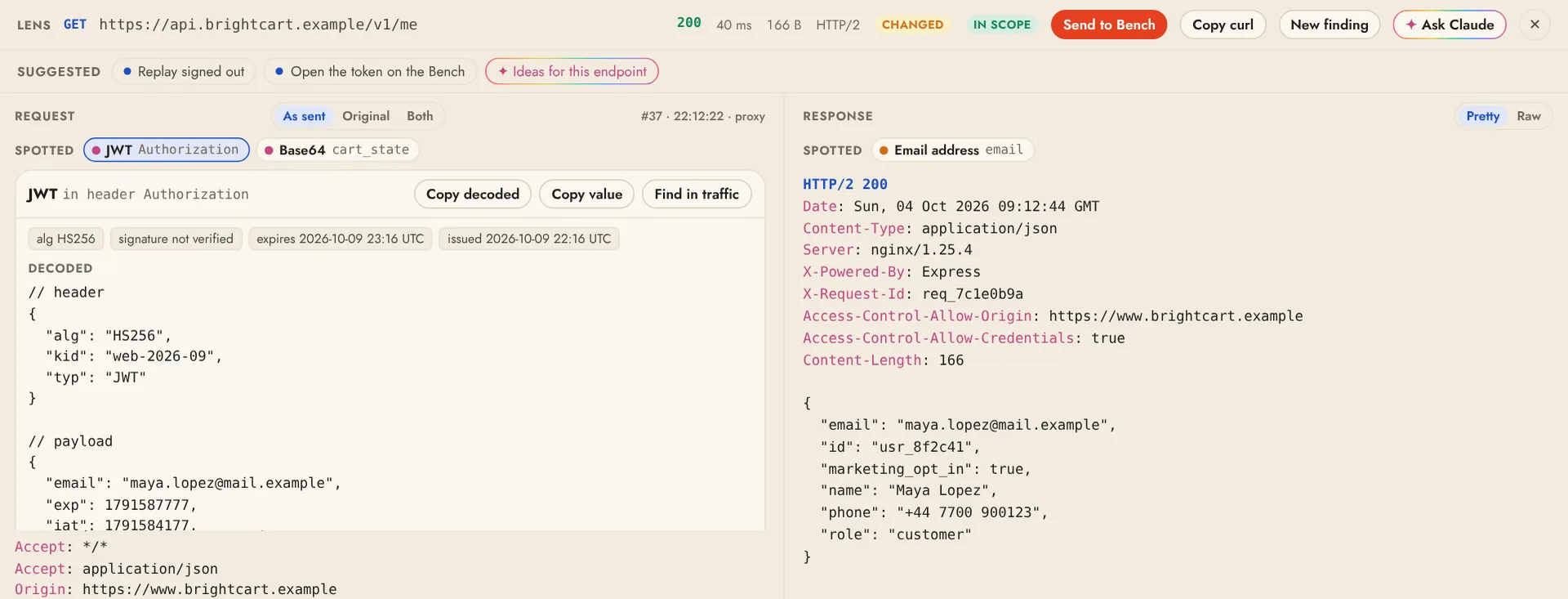
Move the lens over the request. Plonix decodes what it spots, right where it sits.
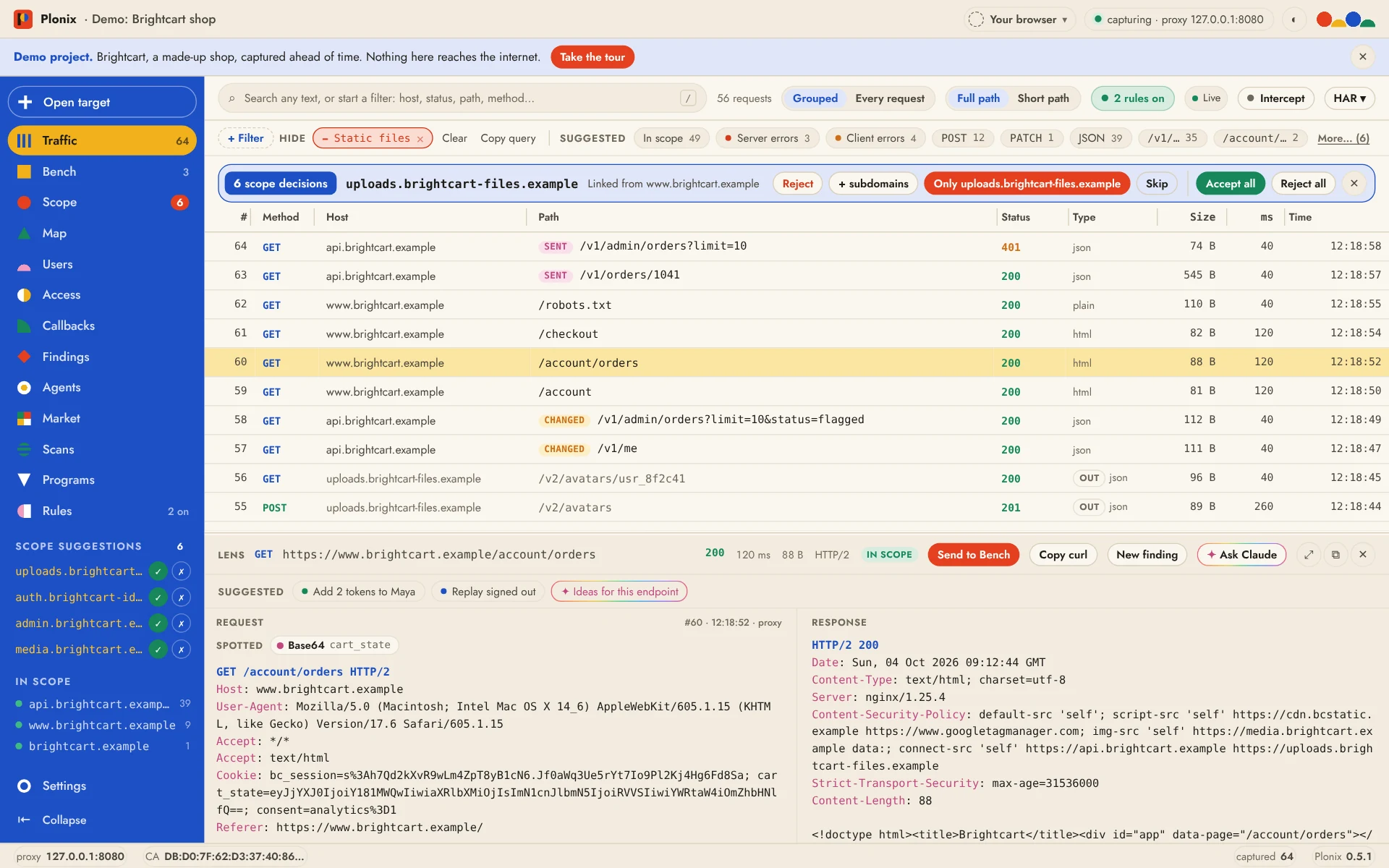

The Plonix window, capturing. A new domain is suggested for scope with the evidence behind it.
Everything a web assessment needs. Nothing it doesn't.
AI-first, built for Claude Code
Built-in MCP gives Claude Code your live traffic, scope and findings in one command. Ask about any request with one click.
AI and agents →Several projects at the same time
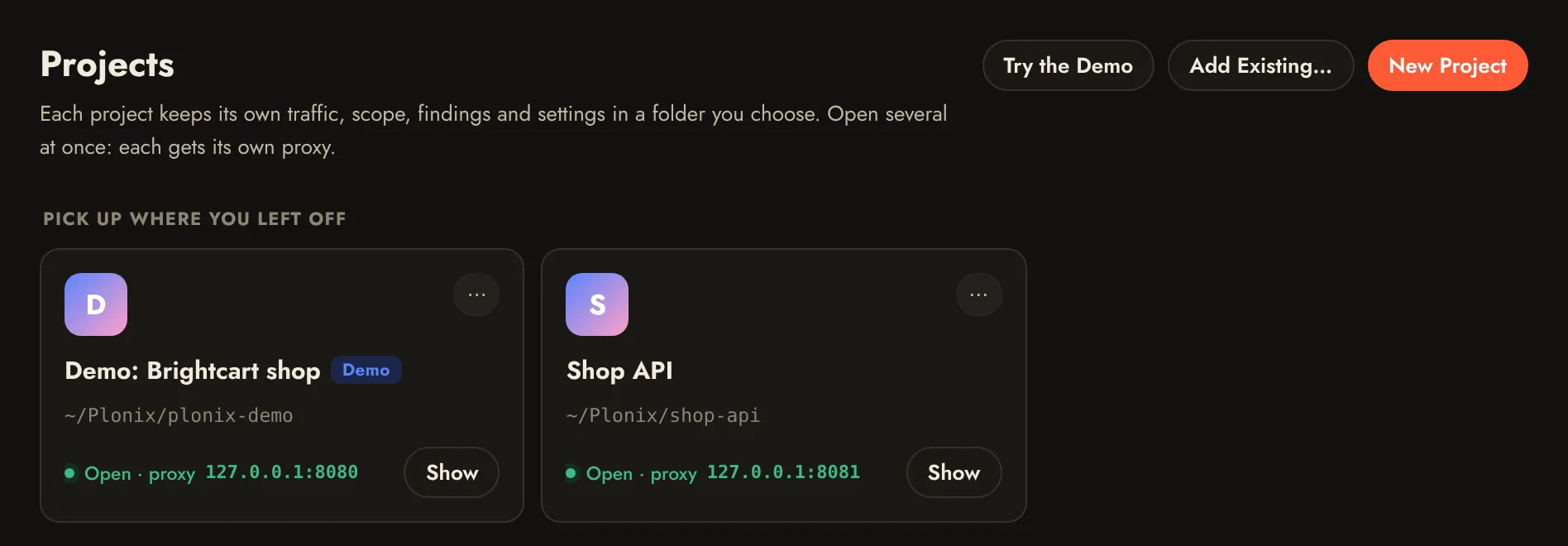
Every project is its own folder, window, proxy and database. Open as many as you need; nothing collides.
Projects →A community Market for everything modular
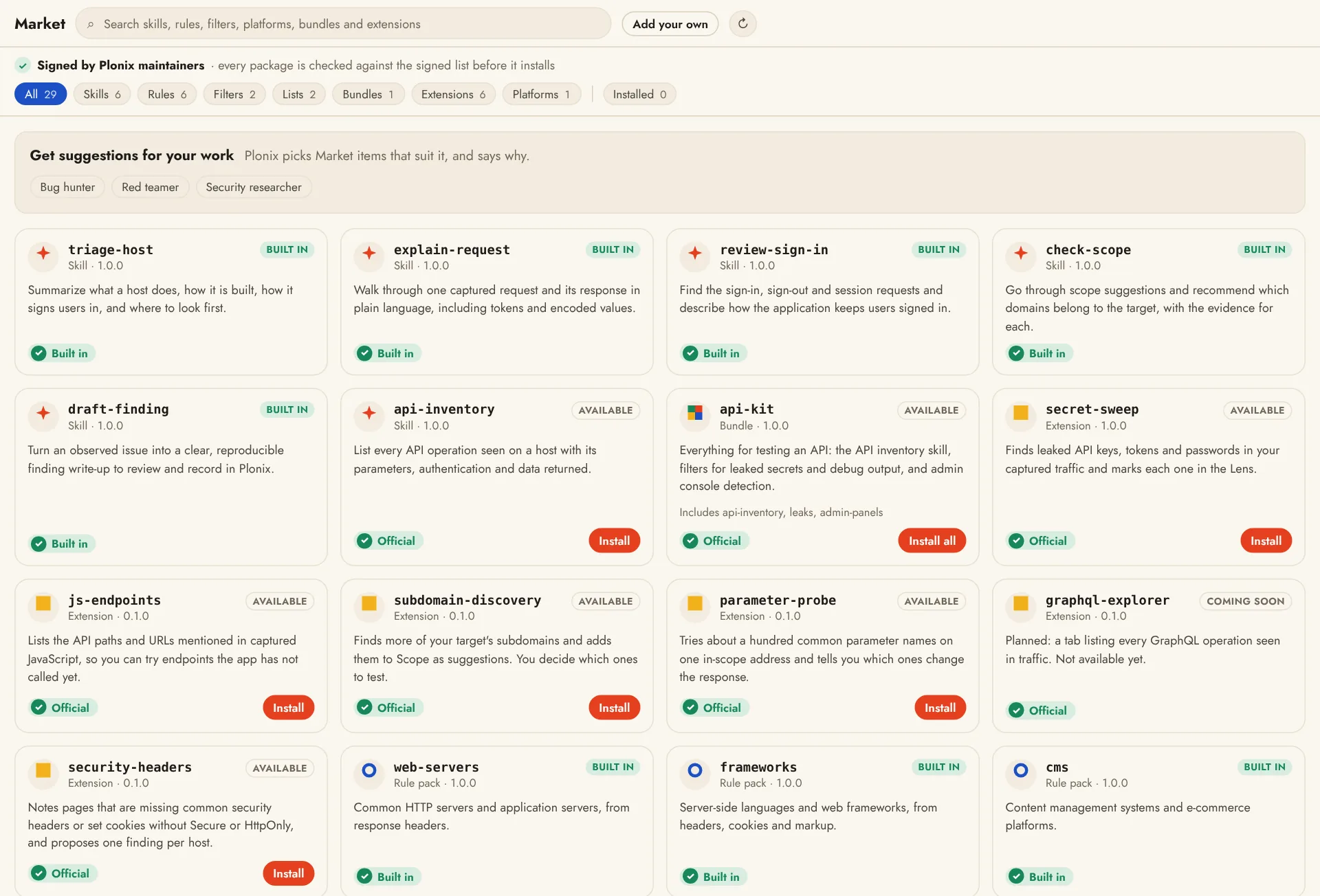
Skills, rule packs, filter packs and bundles, maintained by the community and signed before they install.
Market →Advanced filtering
Type a query or click chips to show only or hide. Save named filters, and use the same query in the CLI and API.
Filtering →Friendly from the first minute
One click or one command sets up the certificate, proxy, scope and a capture browser. A native app on macOS and Windows, with the shortcuts you already know.
Get started →Scope that works, and stays easy
Scope grows as you browse, with evidence for every suggestion. One click to accept or reject, and noise like trackers is excluded for you.
Adaptive scope →Mind Reader suggests the next step.
One-click actions that surface the single most useful next step for whatever is on screen: the right chip, in the right pane, at the moment you notice something. Nothing fires on its own: you click to run, and anything that sends stays in scope.
Pick a moment, then click the chip to see what one click does. This is a preview. The real actions live in the app.
Claude Code can see your project. You decide how much.
Plonix has a built-in MCP server. One command connects Claude Code to the live project: it can search traffic, read requests and responses, see hosts, endpoints and technologies, and review scope and findings. Any other MCP client can run plonix mcp.
$ plonix open brightcart.example        # capture while you browse
✓ Proxy   127.0.0.1:8080
✓ Scope   brightcart.example (+ subdomains)
$ plonix connect claude        # once
✓ Plonix added to Claude Code (read-only)
$ claude
> Use Plonix to find in-scope API endpoints that
  returned errors, then read the most interesting
  request and tell me what stands out.
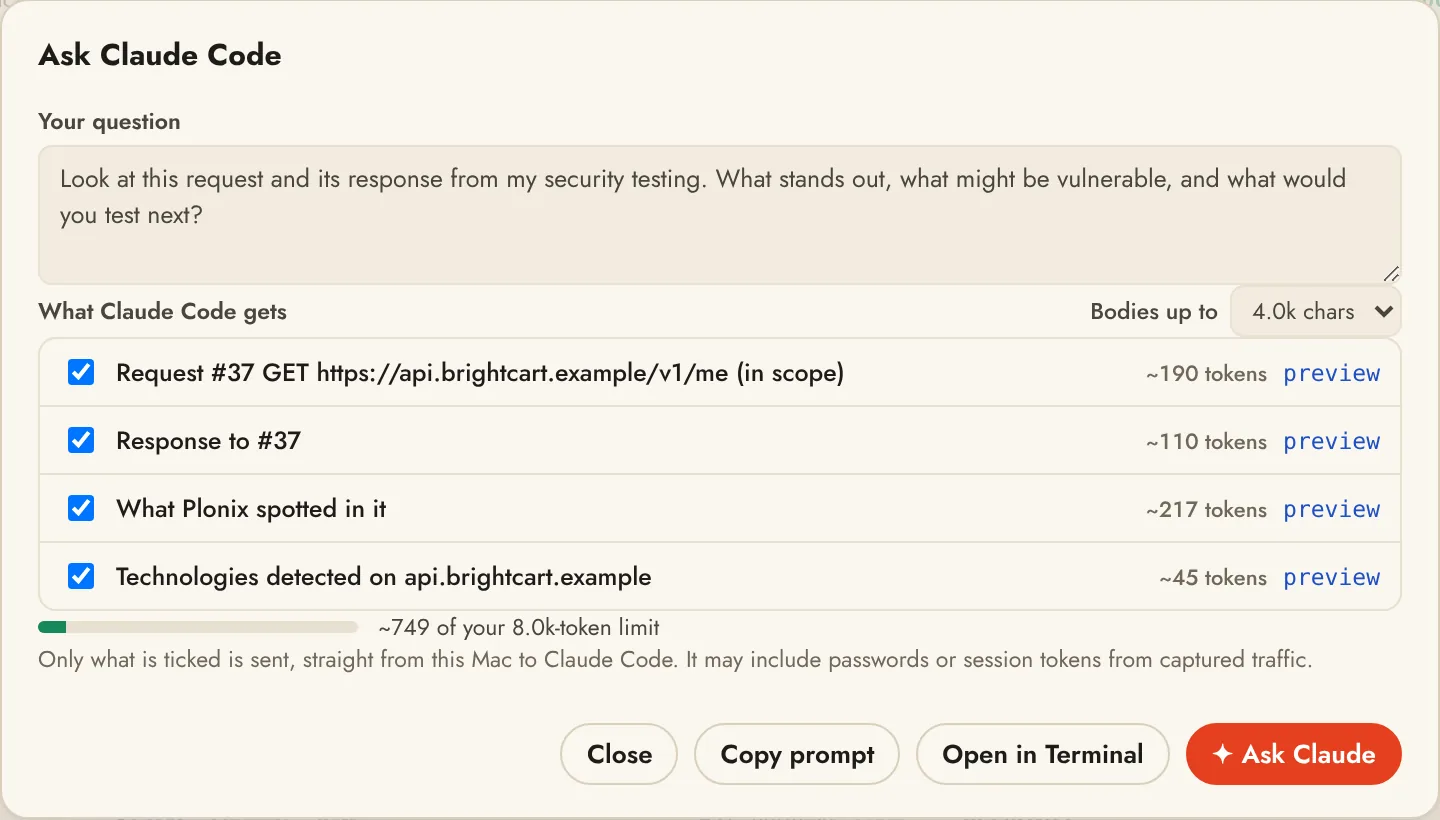
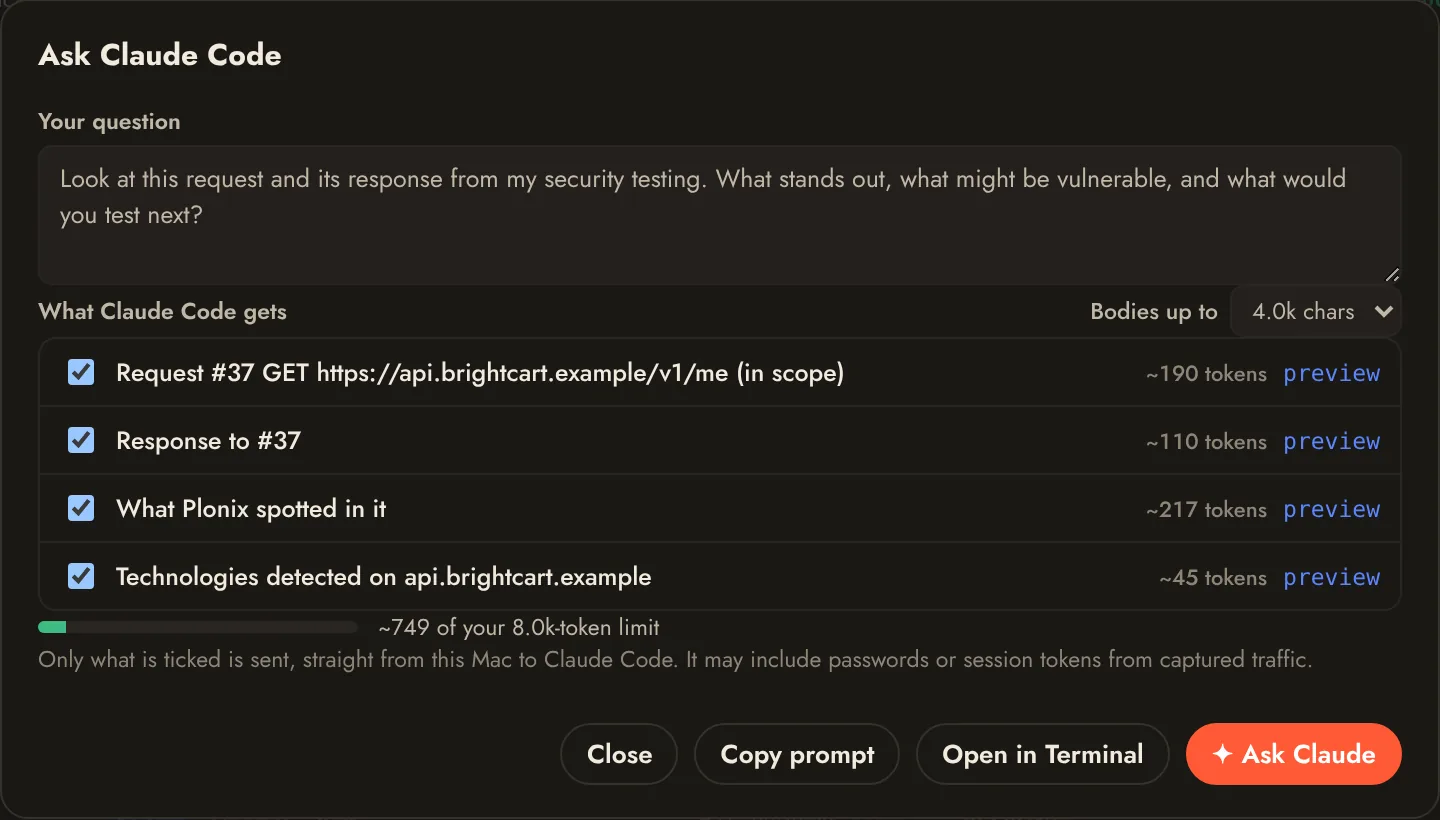
It points at what matters before you go looking.
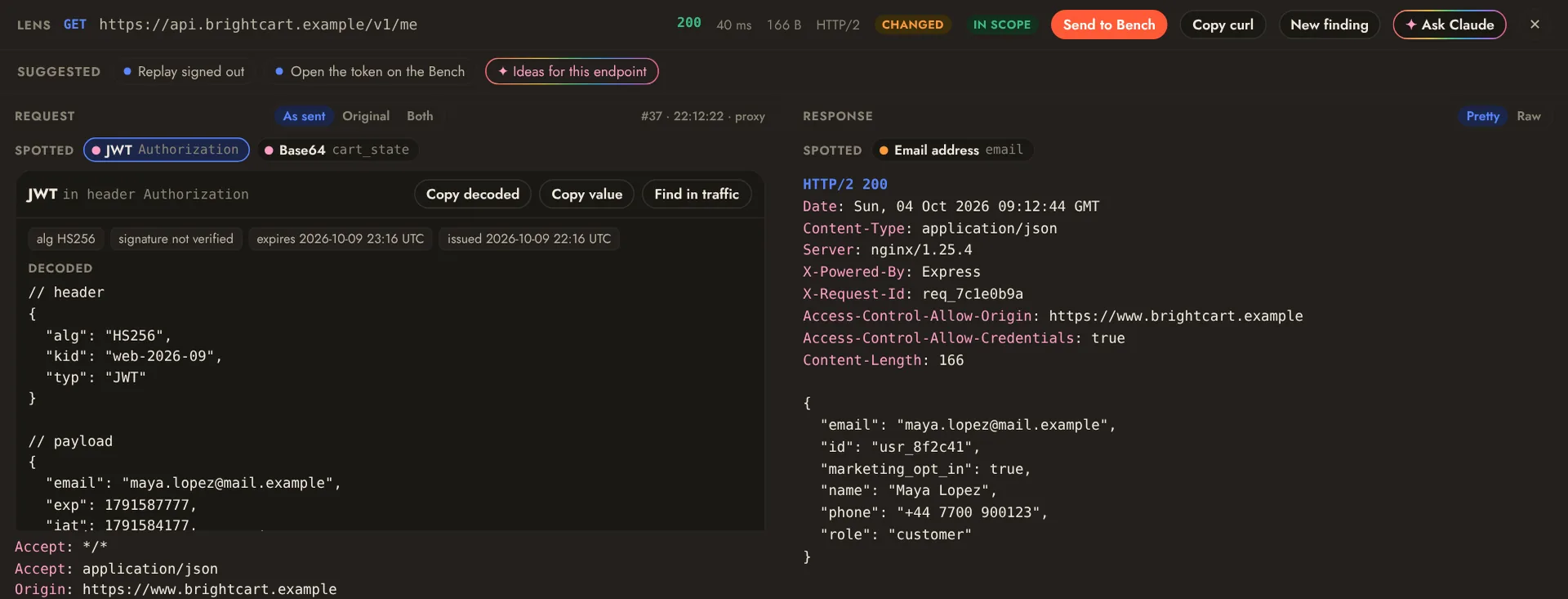
The Lens shows the selected request and its response, decoded and pretty-printed. Above them, Plonix lists what it spotted. Click one to highlight it in place, copy the decoded value, or find it across everything you captured.
Detection runs locally, on traffic you already captured. A token's signature is never claimed valid.
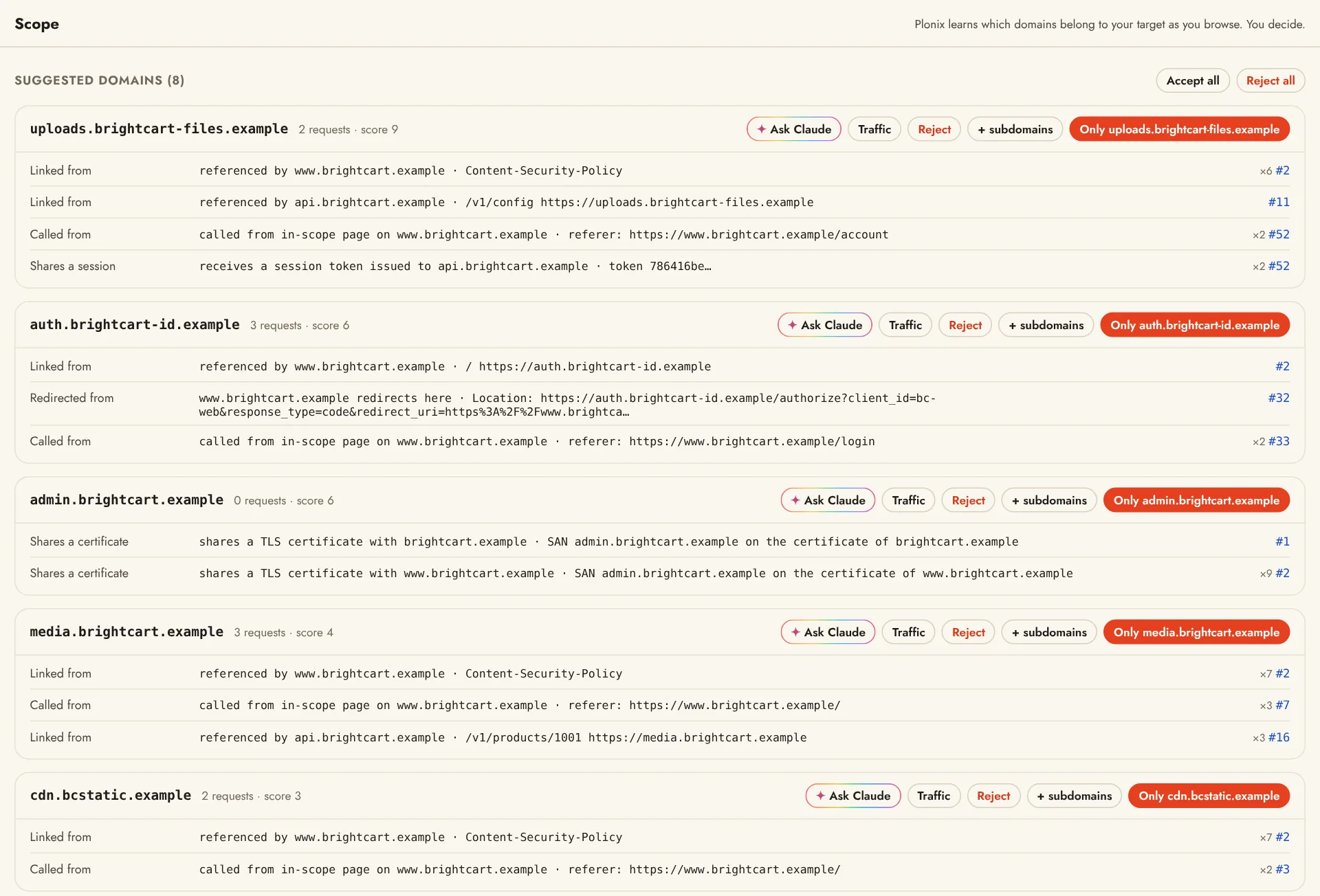
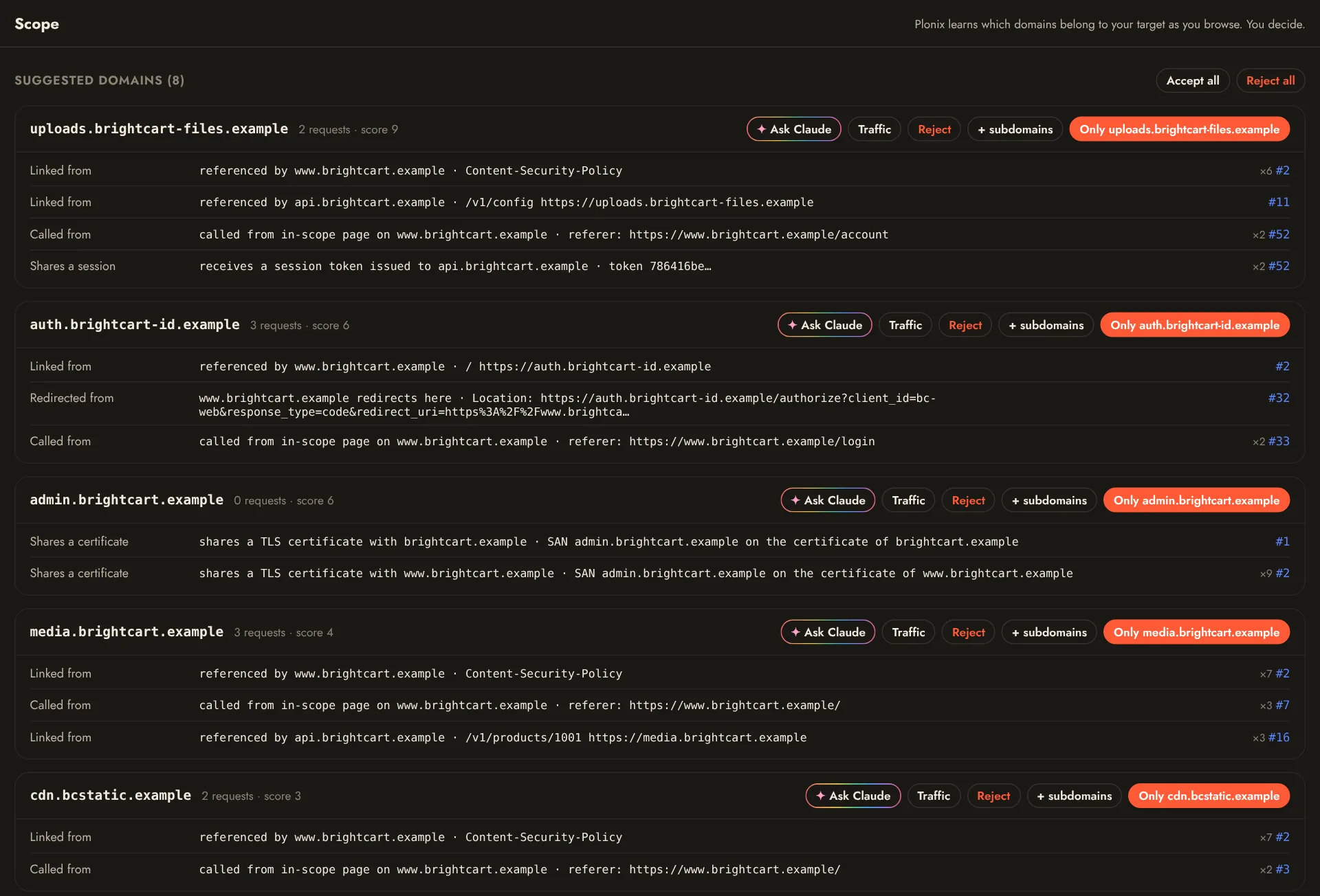
Scope that learns the target while you browse.
Static allow-lists assume you already know every domain an app uses. You find out by using it. Plonix records everything, then suggests domains to bring into scope, each one backed by evidence you can click.
- Called from an in-scope page Referer or Origin
- Redirected or linked Location, page links, CSP
- Shares a session or a certificate tokens and TLS SANs
- Enforced in one place replays, sends and agents can only reach accepted hosts
Filters you can type.
A small query language over URLs, headers and decoded bodies. Search stays quick as a project grows, because every project has its own database. The same query works in the window, the CLI and the API.
Experiments, kept and comparable.
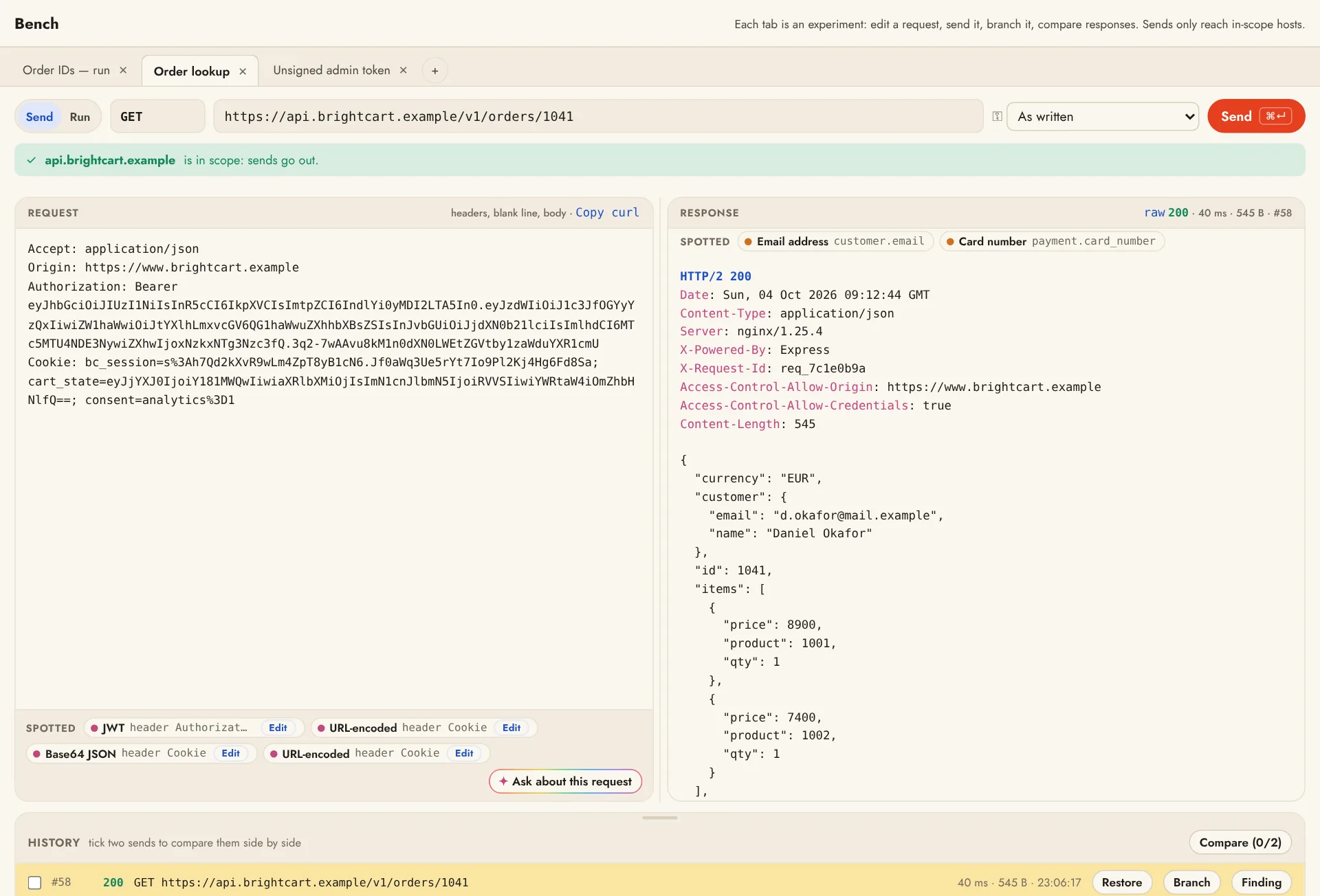
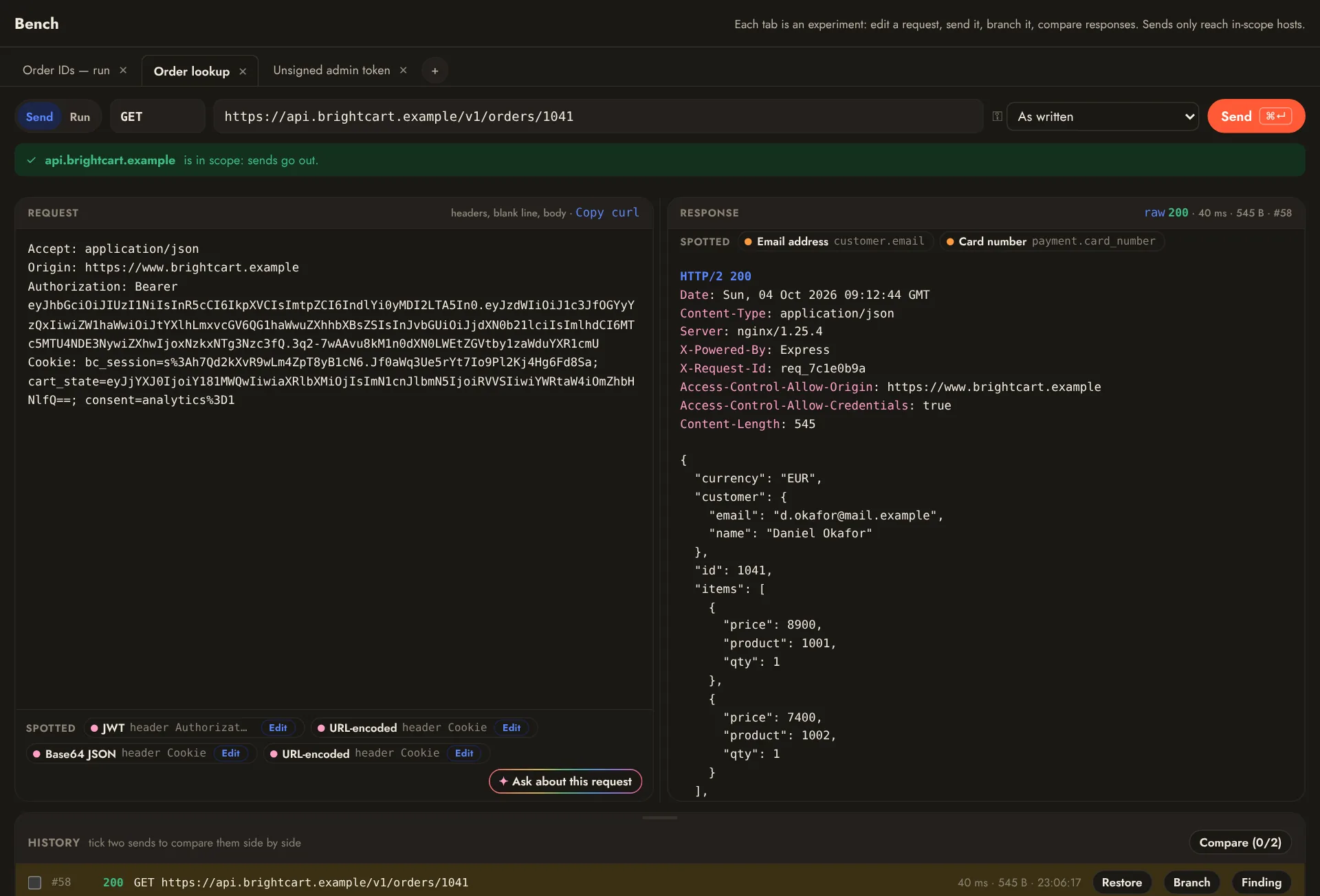
Press b on any request to take it to the Bench. Edit it, send it, and every send stays in that tab's history. Restore or branch any earlier send into a new tab, and put two sends side by side to see what changed.
- Side-by-side response and request diff
- Sends only reach in-scope hosts accept a host right there
- Turn a send into a finding in one click
See exactly what changed.
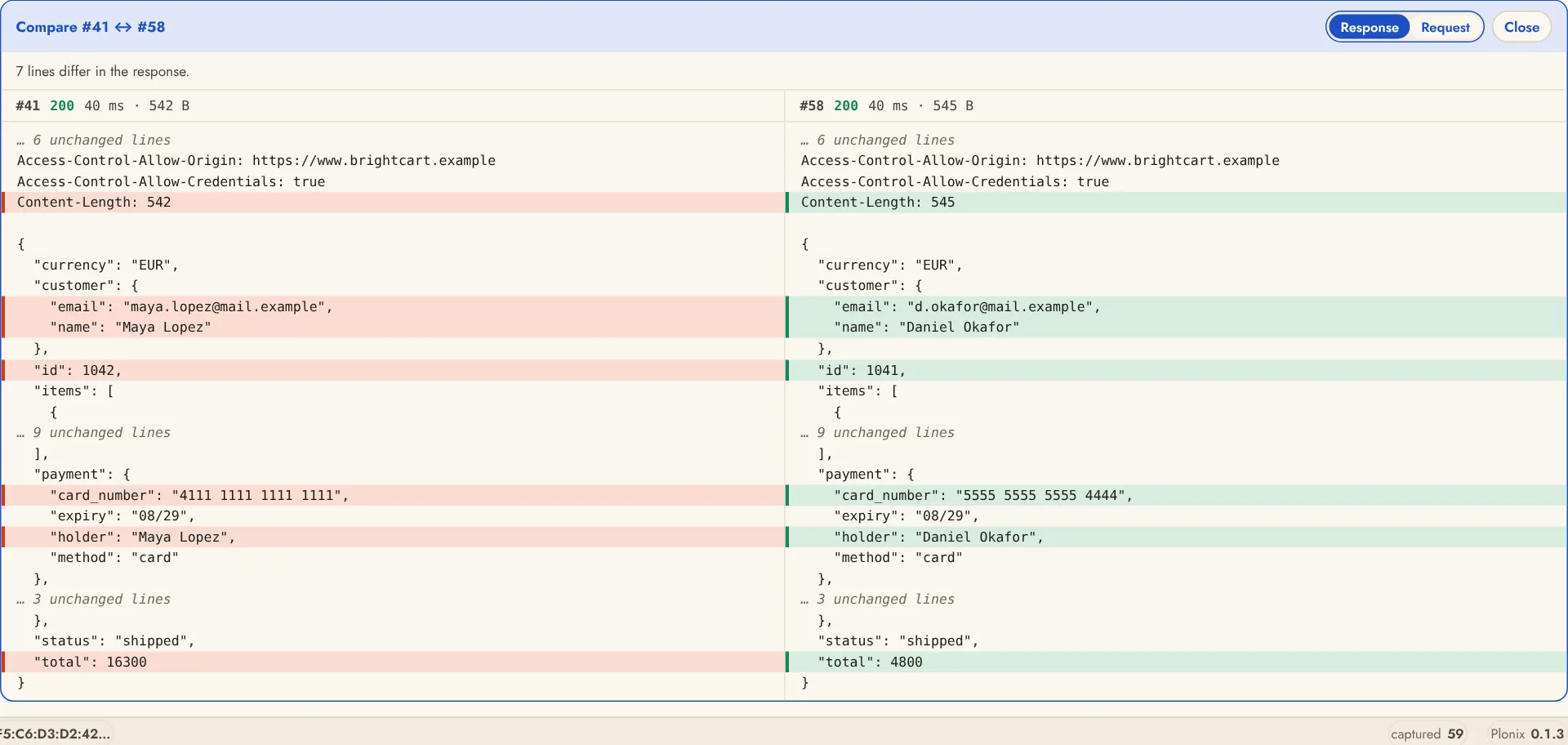
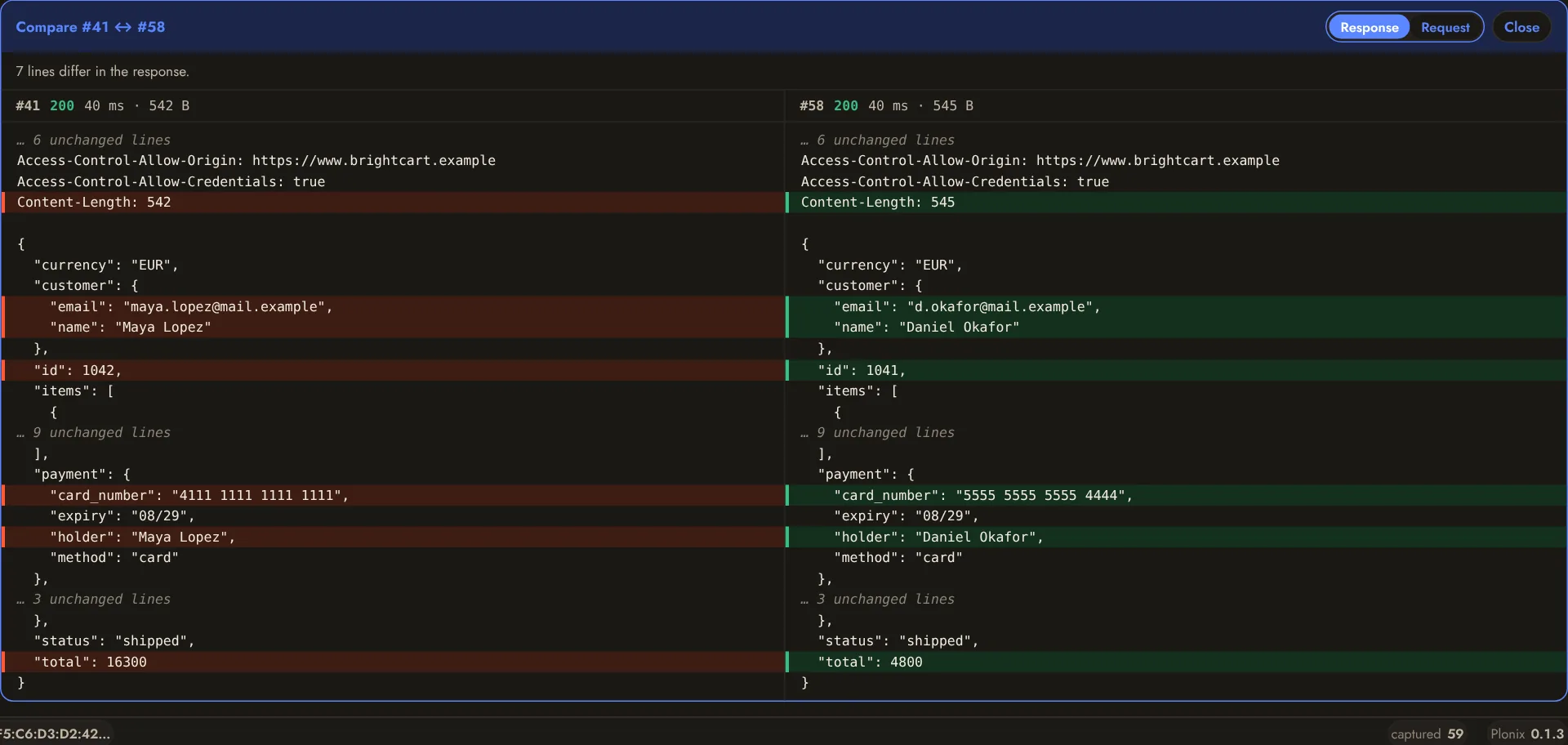
Tick two sends on the Bench and Plonix lines them up side by side. Changed lines are highlighted and unchanged runs fold away. Change an order id, and someone else's name, card and total stand out at once.
- Switch between the responses and the requests
- Unchanged lines fold away
- Any two sends from the tab's history
Several targets open, nothing colliding.
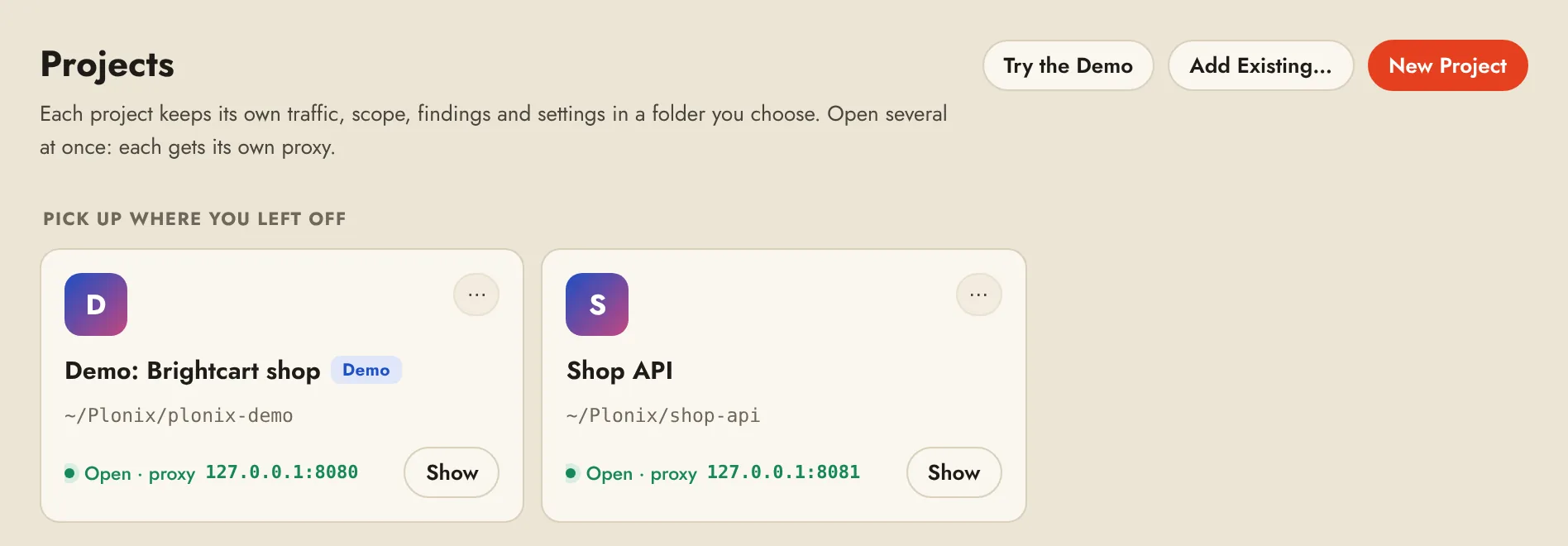
A project is a folder you choose. It holds its own traffic, scope, findings and settings. Open several at once: each gets its own window, proxy port, API and database. Trust the certificate once and it covers them all.
Turn on Keep only in-scope traffic and out-of-scope requests are deleted from disk when the project closes.
Add what you need, and know where it came from.
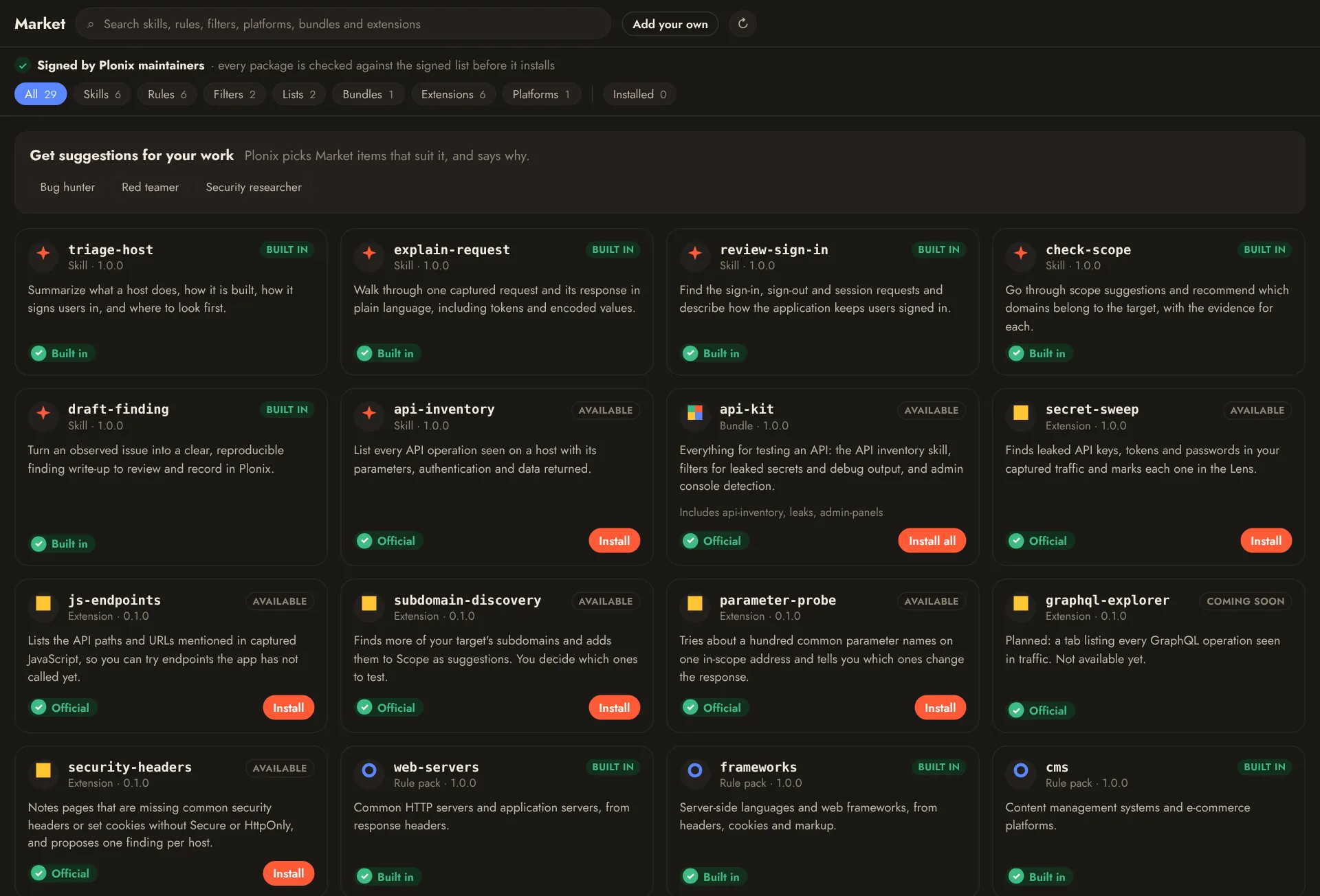
One catalog for everything modular: skills that tell an agent how to do a job, rule packs that recognise technologies, filter packs like is:auth, and bundles that install a set together. Open it with ⌘7 or run plonix market.
- Signed by the Plonix maintainers every file is checked before anything installs
- Clear labels Verified, Built in, Not verified, Changed
- Nothing runs code skills are text and packs are data
- Host your own a team Market with its own signing key
Anything you can click, you can script.
The window, the plonix command and agents are equal clients of one local API, and plonix mcp serves it to any MCP client. Every command takes --json, and exit codes tell a script what happened, down to a request refused by scope.
The API listens on loopback only and needs a token from ~/.plonix/api-token.
$ plonix search host:brightcart.example status:5xx
$ plonix show 42
$ plonix watch scope:in
$ plonix scope review
$ plonix scope accept '*.bcstatic.example'
$ plonix replay 42 -H 'Authorization: Bearer other-user' -t /api/users/2
$ plonix -p shop search status:5xx --json
$ TOKEN=$(cat ~/.plonix/api-token)
$ API=http://127.0.0.1:8090/api

$ curl -H "Authorization: Bearer $TOKEN" -G "$API/traffic" \
    --data-urlencode 'q=host:brightcart.example status:2xx'
$ curl -H "Authorization: Bearer $TOKEN" "$API/scope"
$ curl -H "Authorization: Bearer $TOKEN" -H 'Content-Type: application/json' \
    -d '{"domain":"*.brightcart.example"}' "$API/scope/accept"
$ plonix connect claude     # adds Plonix to Claude Code, read-only
✓ Plonix added to Claude Code (read-only)

# any other MCP client runs it over stdio:
{ "mcpServers": { "plonix": { "command": "plonix", "args": ["mcp"] } } }
Captured traffic in under a minute.
Mac: Apple silicon and Intel, macOS 11 or later. Plonix is in early development and not notarized by Apple yet: the first time, open it from System Settings › Privacy & Security › Open Anyway. Windows: 64-bit Windows 10 or 11; the installer is not code-signed yet, so click More info › Run anyway if SmartScreen asks. How to open it the first time, with pictures · All releases
$ git clone https://github.com/SergeyMalych/plonix.git
$ cd plonix
$ cargo install --path crates/plonix-cli
$ plonix open example.com
✓ Certificate  ~/.plonix/ca.pem  (created)
✓ Proxy        127.0.0.1:8080
✓ Scope        example.com (+ subdomains)
✓ Browser      isolated profile, trusts Plonix
Capturing. Browse the site.